
Hardcore Formalism
The Dennis Cooper Interview


(This is the full-length, original, mostly unedited English version of my interview with Cooper for Revista Guilhotina. You can read the Portuguese translation there, along with a much lengthier, somewhat educational introduction)
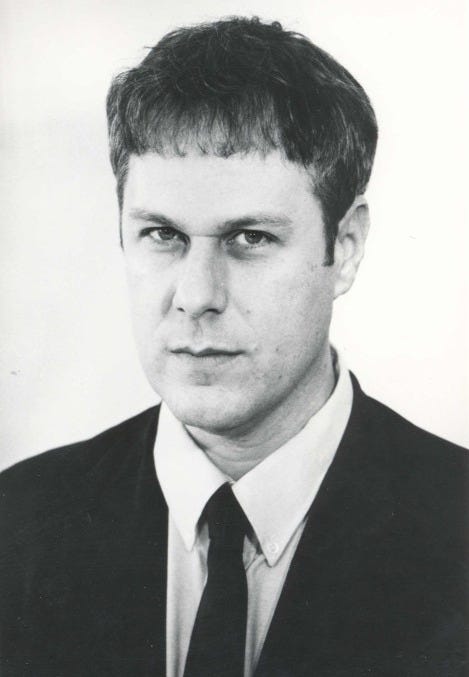
This has been a long time coming. Anyone even slightly familiar with my output and nonstop Instagram bookposting through the years has been made aware of how much Dennis Cooper’s work means to me. More than most. I’ve described it as a “pillar” before, though being the anarchist he is I’m sure he’d sneer at anything even remotely hierarchical. It’s probably more like lineage - every writer has their own. A transmission of vision that is then repurposed, rearranged, retransmitted onwards and onwards. Ever since he raved on his blog about the first piece of mine that got published in SCAB, we’ve been on-and-off exchanging personal Q&A’s and updates. Now we call each other “friend”. Yeah, I’ll brag. No need for big introductions here; if you know him, you know him. More than ten books, from novels to short fiction to essays and poetry. Digital art, performance, journalism. For a decade, since his and Zac Farley’s first directorial collaboration, Like Cattle Towards Glow, he’s been all about film. At the time of this interview, he’s moving from screening to screening to introduce their newest, Room Temperature. We went through it, his latest short fiction collection Flunker, and much more in the following interview.
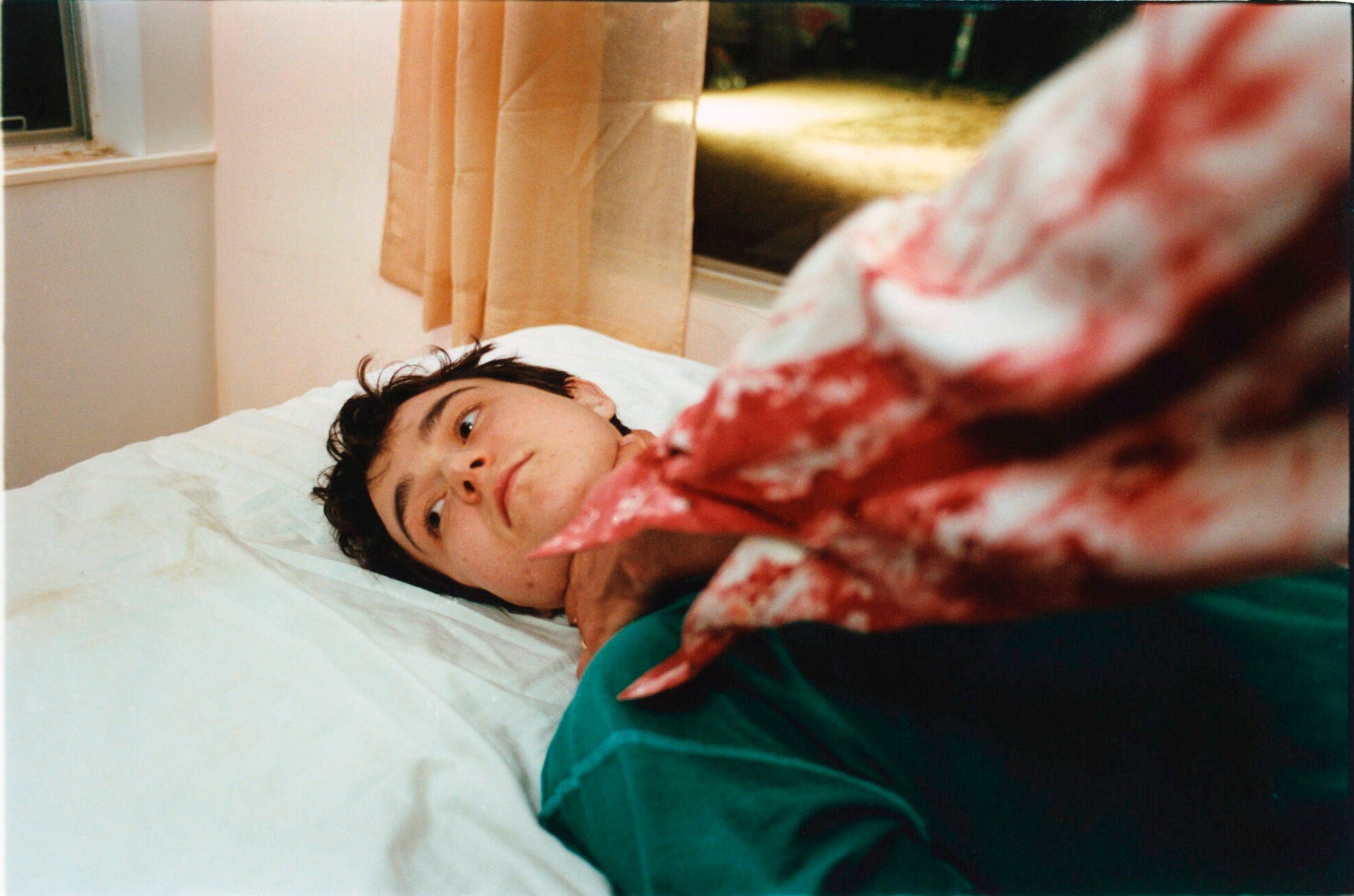
Pedro Minet: So I’ve been keeping up with the release of Room Temperature. It’s been screening in a lot of places, right? Can’t wait to see it. How has the reaction been so far?
Dennis Cooper: It's going really well. It's kind of a strange, unique film. It asks you to pay close attention and unravel it on your own a bit. Most people who've seen it have found that pretty compelling, but there are always people who want films to tell them what to feel and to make then not have to think, so the film has proven, as we expected, not to be everyone's thing. But my own work has always been like that too, so that's not a problem.
Minet: Can you tell me a little bit about the movie? I know it has to do with haunted houses, which is a recurrent fixation of yours. Seen some pretty bloody stills of it floating around social media, which make me assume it's a bit of a departure from the more austere ambience of Permanent Green Light. But I could be wrong.
DC: It's wilder than Permanent Green Light, but it's still austere in a way. Or maybe a better way to describe it is that it's still introverted and kind of withholding. It's more comedic, and that changes things. Yes, it's about a family that builds a haunted house attraction in their home. And that leads to other things happening, most of them not good.
Minet: I remember when you started venturing into film you were expressing dissatisfaction with the literary medium and sort of grasping for new expressions. You’ve always been pretty multidisciplinary, with your collaborations with Gisèle Vienne, the GIF novels, that Horror Hospital graphic novel. Since then, though, you've released two books, I Wished and most recently Flunker. Did the experience with film end up transforming, maybe even revitalizing, your relationship with writing? I know you've always said that your writing was more informed by an aesthetic philosophy of film, i.e. Bresson’s, than literature per se. I wonder how directing yourself has now impacted that perception.
DC: Well, it transformed my relationship to writing in the sense that I'm really only interested in making films at the moment. All my ideas are immediately gravitating to film and not to fiction much at all. I love writing fiction, novels particularly, but I've been writing novels since I was young, and I think I understand what I can and can't do in fiction now, which makes it less exciting to me. Film is still a frontier, and I feel like I'm only beginning to understand what I can do there. I've always been drawn to big challenges as an artist, things I'm not sure I can actually accomplish, which is what makes me want to try. I haven't had an idea for a novel that seemed difficult enough to want to write since I Wished, but I probably will again. Right now, film is the inviting, scary place I want to work.
Minet: Are you writing anything right now? If so, can you tell me about it?
DC: Predictably, I'm writing the script for Zac Farley's and my next film. I don't want to say too much, but its main characters are a 12 year-old puppeteer and a young guy who takes LSD and then doesn't know who he is anymore.
Minet: I feel like you’ve told your origin myth many times - dreaming of being Rimbaud as a teen, rewriting 120 Days of Sodom starring your classmates, that one teacher in college telling you to drop out to become a real writer -, so I won’t rehash it. I’d like to go over some specific books to sort of trace a general panorama of your output from the beginning and get into more specific aspects of it as we go. Seeing as this is kind of your introduction to Brazilian readers. You first started pretty ingrained in poetry circles; your debut, Tenderness of the Wolves, was mostly a poetry collection. Since then you’ve released some others, most comprehensively The Dream Police, but prose quickly became your main fixture. How was that transition like? Did you always know you wanted to write novels, or was it a gradual discovery? Do you consider your “poetry brain” and “prose brain” as somewhat different entities or are they constantly bleeding into and informing each other?
DC: I always wrote poetry and stories since I was a child. When I was 15, I decided I wanted to be a novelist and to write experimental/avant-garde novels in particular. So that desire came first. I was always writing both, but my poetry got better more quickly while my fiction was really terrible for a long time, so I worked on it in secret and started publishing my poems first. Tenderness of the Wolves had three short fiction pieces in it, so fiction was already starting to break through then. At some point, my fiction finally started getting to a point where I was satisfied with it, and, around the same time, I felt like I couldn't go further with my poetry. I realised that I didn't have it in me to be as good a poet as I wanted to be, so poetry faded out. I came to writing fiction through poetry and experimental fiction. I never learned how to write fiction or novels in the normal way, and I never wanted to learn how to do that. I think when my fiction gets emotional, that's probably whatever is left of the poet in me. I associate writing poetry with being overly emotional.
Minet: After Tenderness of the Wolves, before the big breakout with the George Miles Cycle, there was My Mark, a chapbook, which then got repurposed into Safe, a novella. It definitely has a raw “early work” quality but already features so much of what would remain hallmarks of your work. The Bressonian transcendental precision of the prose, the way you structure language so that a very ordinary-seeming sentence at first feels like some sort of elusive miracle once you get to the end of it. The spiral-like, surgical sequencing of scenes, and of course, all the sex, violence and those wandering, barely intelligible twinks. I feel like you’re the sort of writer who has never tried to not be obsessive about the symbols you’re obsessed by. Like a still life painter. Always finding new ways to build around similar objects. Have you ever tried to interrogate yourself about this? Or does it seem besides the point? And what’s that relation to you like in terms of form vs. content? Which one usually comes first, takes precedence? How to then integrate them, sew them into one body?
DC: I think my writing is the interrogation. That's where I try to figure out my obsessions and myself. Not that I ever have, of course. Otherwise I would have probably quit writing. For me, content services form. The content comes first in the sense that it's what makes me want to write, but, when I write, the content becomes kind of an underground force. It fills the form with meaning, and I'm always in the grip of the content, but its power over me is such that I don't need to think about it. All I think about is how to represent it and shape it.
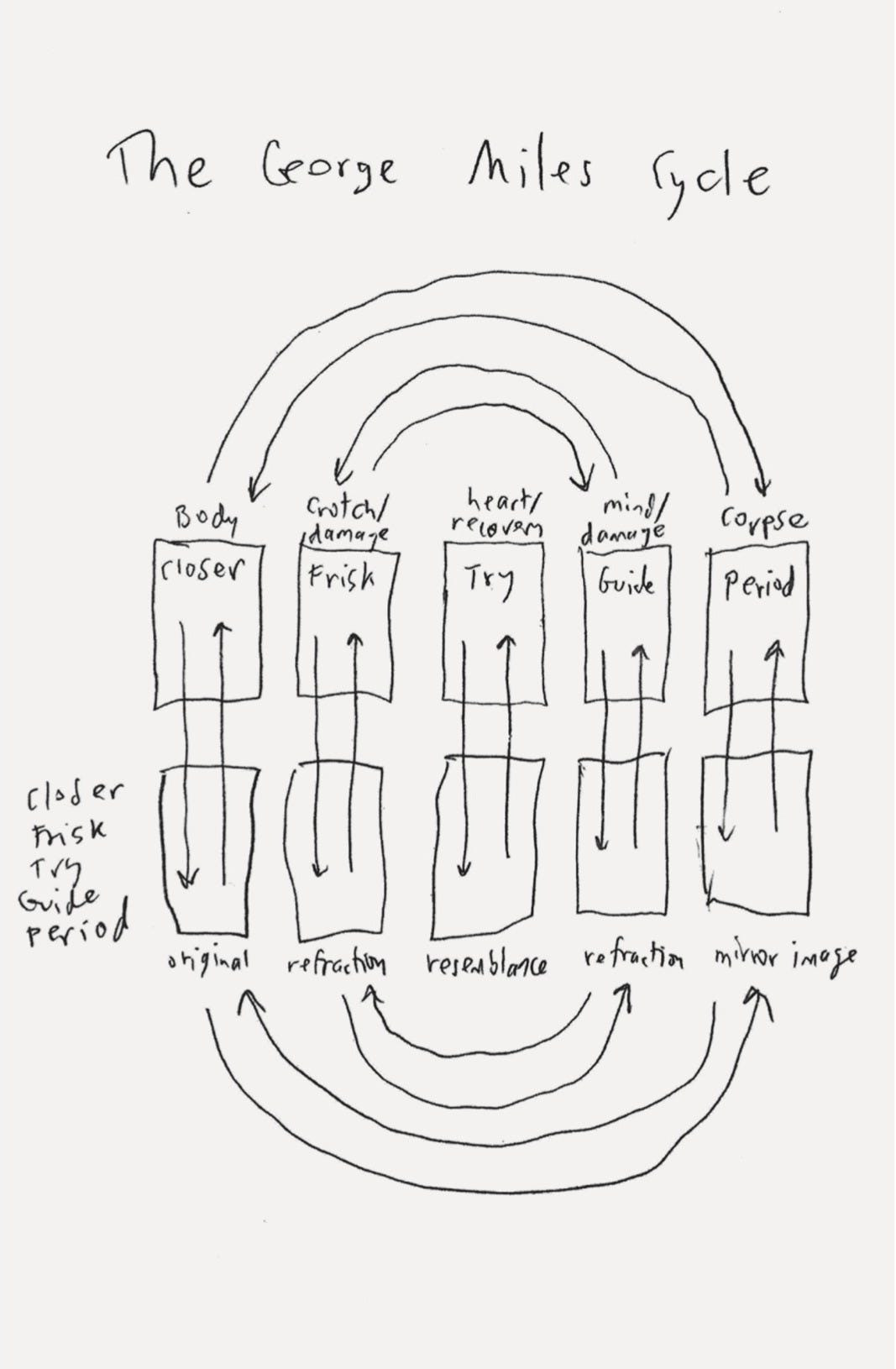
Minet: Closer was the first book you published with Grove Press; it marks the beginning of the five-part George Miles Cycle and in many ways works as a synthesis of it. I could do an entire interview just on this one. It’s probably my favorite novel of all time, and we’ve discussed aspects of it before. It features the literary debut of George Miles, in his original, real-boy body, before he gets dismembered and refracted and repurposed in so many subsequent iterations. You’ve said the Cycle is like a body, George’s body, with each installment being a piece of it. Closer is the “original body”. The structure of the novel works so that each chapter is told from a different character’s POV as they cross his path. Beginning as a punk boy’s art project, then slowly coming into A Room of His Own just to thrust himself into brutal mutilation and end up in eternal darkness on another punk boy’s bed. This George has often been described as “passive”, but I’m not sure I see him this way. In many ways, his surface submission is a (doomed) journey of radical discovery. Treasure hunting. Into a sort of hole - of abjection, transcendence, mythmaking. His own? There’s a scene when he tries to see inside his own ass in the mirror, “hoping to see what the men were so wild about”. He compares it to one of his favorite Disneyland rides. In Period, the last book in the Cycle, its “corpse”, he comes back, this time saying he now can travel through mirrors. Maybe this is what he was after. But that’s just my take. God, there are so many things I could ask. I think I wanna know more in-depth about how you conceptualized this book, if you can remember it. The structure, this rotation of characters, of voices. So much about it is so specific, like how each one of the boys who cross George has a specific medium they work with (one with drawing, the other one film, another one music), the dichotomy between the two twinks David and George, Philippe’s dialogue with Death. Was it a long process until you finally reached the final result? And did you already have the rest of the Cycle fully planned out at this point or more of that general “body” scheme?
DC: The process of developing and writing Closer was really long and very complicated, so I can't really take it fully apart. I don't remember a lot of it. I was always developing and devising the Cycle itself. I didn't know how many books the Cycle would contain initially, but it was the overall structure and build and so on of the Cycle that was my concentration. Technically, I started trying to figure it out when I was 15 although I changed what I wanted to do many times before I finally started it. Closer was particularly hard and time consuming to figure out because, in the kind of complicated structure that the Cycle involves, it had be the world of the Cycle. One of the structural principles is that the Cycle is a single body being gradually destroyed and revived along the way. So Closer had to contain everything that was going to be in other Cycle books because I decided not to let myself add anything that wasn't represented or referenced in it. At the same time, the Cycle structure was open enough that I could incorporate what I was really interested in while I was writing each novel. It's hard to explain. I had lots and lots of graphs and things I made to work from. Closer was the world, Frisk was the libido, Try was the heart, Guide was the mind, and Period was the world after being all but destroyed. So, yes, the Cycle was planned out in a fundamental way when I wrote Closer. That's not to say that each of the books wasn't also a surprise to me.
Minet: The figure of George haunts your writing as its supreme muse. Not just the real George, though he was very real (as you’ve made sure to remind readers many times through the years, most recently in I Wished) but his metamorphosis into character, archetype, concept, verb, syntax, everything-as-nothing-as-everything. These negotiations between his flesh and his afterlife-as-art are reflected in so much of the dynamics between the boys in the Cycle and the men who watch them, want them, love them, kill them, write them. It is a play you as the author (and narrator) partake in and implicate yourself in so consciously, so nakedly that in the end it feels redemptive. Though never necessarily resolved. I’d like you to talk about this rapport, and how you feel it’s developed through the years. These dynamics of writer vs muse, “Dennis” vs “George”, objectification, idealization; your role in them and what you feel your “goal” or “mission”, if you could call it that, in that exploration is. Feels like it's at the root of your work’s perspective.
DC: As much as I'm a hardcore formalist and stylist, I'm also a very intuitive writer. I've never had a mission or goal or anything like that other than trying to make each of my novels special and hopefully worthy of its existence. My work is very focused because my inspiration as an artist is very particular. I am still trying to figure out the things I was trying to figure out when I started writing. I'm compelled to write about what I write about. I honestly don't know why. So I don't really think about writer vs. muse or about idealisation and so on. When I write a novel, I'm trying to figure out myself and my obsessions and the novel form in a new way that will finally get to bottom of them. But I don't have any guiding principles or anything like that. At least that I'm conscious of.
Minet: After Closer came Frisk, with its much more showy and fantastical brutality that garnered a lot of controversy at the time. Fun times for “transgressive” gay writers, with it coming close in time to American Psycho and Fight Club. It’s one of your most famous books. It pushes those questions of fetishism and make-believe to a simultaneously darker and sweeter place than Closer. I’ll ask a somewhat silly question now. What was your process like, then, when writing extreme sex and violence like the one in that book? And how has it evolved? I’ve read you would deliberately stop typing whenever you got horny or something. That’s different from someone like Guyotat or Acker who always talked about jerking off while writing. Is it all about language for you? You’ve criticized work like Von Trier’s, Pasolini’s Salò, etc. in how they treat this kind of content, so you seem to have a kind of code around it.
DC: When I write about those things I'm trying to give them their full power, or at least the power they have over me. At the same time, I'm thinking about what kind of representation will pass that power to the reader without aggressing them or being sadistic to them in any way. I think a lot about power dynamics when I write. I'm an anarchist so that dynamic is something I think about all the time and try to be responsible about in my life even on really basic levels. My work isn't masturbatory because I think that would lead to self-indulgence and would interfere in my interest in communicating in a meticulous way. When I was younger I studied how glaring/shocking things were generally represented in books and films to see what methods allowed a viewer to enter those things emotionally or intellectually and which used them as an excuse to represent psychological interpretations and which just resulted in cheap thrills. And I developed a way of representing them that seemed both fair and unstinting to me. It still doesn't work on most people because I don't think there's anything that can prevent people from being shocked who don't want to deal with those things,
Minet: Frisk got a lot of backlash at the time from certain sections of gay activists and literary gatekeepers. You’ve been pretty adamant about distancing yourself from the idea of “gay literature” or “gay art” or “gay community” or "gay anything" in general since the beginning of your writing career. What were you fighting against by rejecting those labels and the direct politicizing of your work?
DC: I'm not interested in collective identity. I think generalising never leads to the truth. I think seeing individuals as examples of some grouping formed by the beliefs or identities that they have in common with others who appear to resemble them in some way results in lazy thinking and interpretations. I respect people who take strength from, say, being gay and living and doing their work under that label. I just personally don't think my being gay is any more important than whatever other qualities I have.
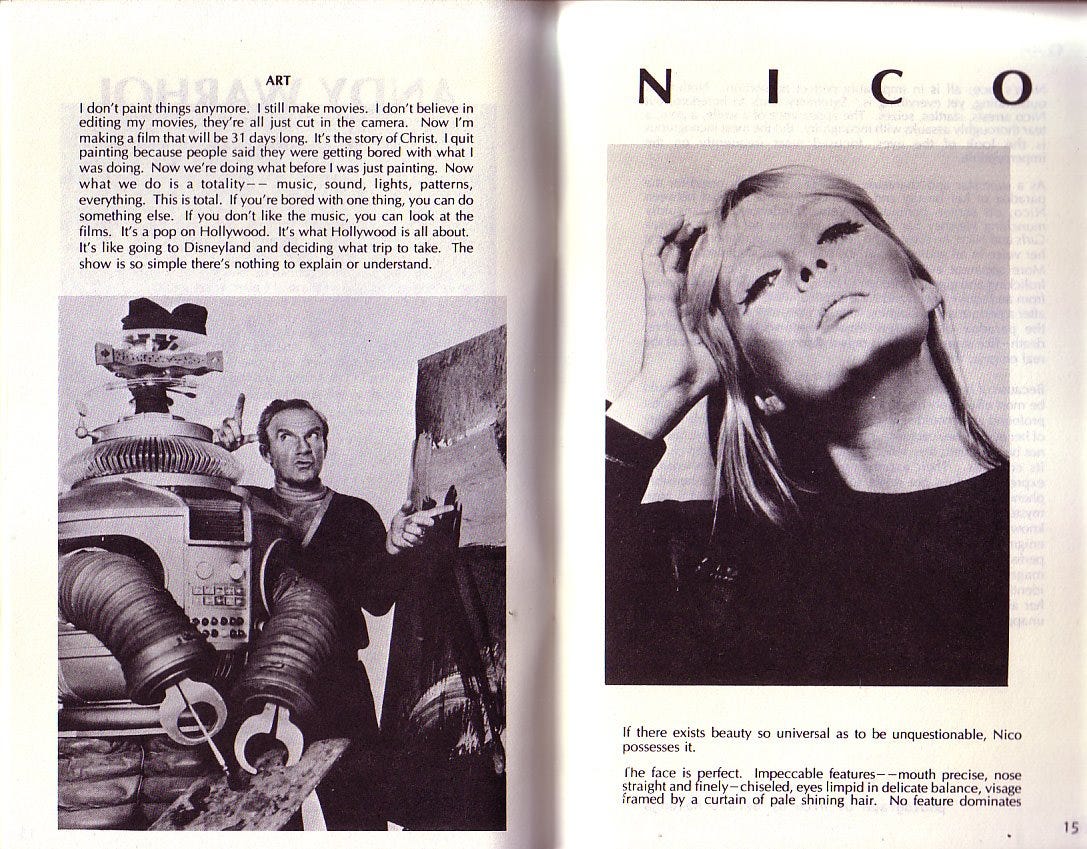
Minet: Third book on the Cycle is Try, the “heart”, but I’m skipping that one. A bit too emotional for me. Onto Guide, one of my favorites. The “mind”. Which was written around the time you were working a lot as a journalist for magazines such as SPIN, interviewing some pretty legendary people - Courtney Love, Leo DiCaprio, Brad Renfro, Christian Bale, Nan Goldin, Stephen Malkmus, Ryu Murakami -, writing obituaries for River Phoenix, Burroughs, etc. This is directly integrated into the novel, with an entire subplot about you interviewing that sickly street-hustler-with-a-band for SPIN, the whole book woven with this manic pop culture logic. There’s the infamous Blur stand-ins, the 90s techno scene, lyrics constantly intruding into the narration, that LA vertigo pace. Like Closer on stimulants, or a Guided by Voices song. You had experience pretty early in your career running a zine, Little Caesar, which also featured a bunch of then-cultural icons. Even Warhol. In a way, your long-running blog also functions as a zine, with constant collaborations from users, daily features on artists and current fixations. How do you see that side of your output? Does it feel like something separated from your work, more of a social, community-building thing, a daily ritual, or has it helped to arrange your thoughts on the art you’re currently working on? Also how was Brad Renfro? I’m kind of obsessed with him.
DC: Yes, the fact that I was doing a lot of journalism at the time definitely fed what Guide ended up being. There's a big aspect of me that loves curating. I did Little Caesar Press, and I curated a big reading series in LA in the early 80s, and I edited a literary imprint called Little House on the Bowery for a while, and I used to curate art exhibitions at galleries and museums a fair amount. The blog is part of that impulse. I like to draw attention to art and things that I think would possibly inspire others. And I really like having a situation where I can support younger artists. It feels separate from my work as an artist. But that other interest or need has always been there. Brad Renfro was the most troubled well known person I ever interviewed. He was very polite but very withdrawn. He clearly did not want to be there. At the same time he was very honest to the point of telling me things about himself that he really shouldn't have. To the point that his managers threatened me afterwards to not print a lot of what he'd said or they would sue the publication I was interviewing him for.
Minet: The Cycle ended as the millennium turned, ushering more standalone work. My Loose Thread, The Sluts, God Jr., The Marbled Swarm. The Sluts in particular seems to have cemented itself as a kind of touchstone. Recently it’s been making rounds in online circles here in Brazil. Feels like a prophetic work about so much of how we negotiate identity and truth and desire and violence in the digital age. Reading it is a bit like doomscrolling. At the same time it’s pretty evidently of its time, with message boards and this pre-Grindr, post-AIDS, pre-PrEP conundrum of gay sexual horror. Can you talk about where your head was like at the time of writing it? How did the concept come across, where were you trying to get at with it, and how satisfied have you been with its continuous reception?
DC: I spent about ten years off and on writing The Sluts. A very early, very different version of it was going to be the 4th novel in the Cycle, but I couldn't make it work. I started writing it before the internet. When the internet happened and, in particular, when the escort review sites and message boards appeared, that finally made it possible to do what I had intended. Originally it all took place in letters and faxes and personal ads and things. Basically, in its final form, I was obsessed with what was happening on those sites and message boards, how guys were turning escorts into their perfect idea of an escort to the point of implausibility and claiming things that were obviously lies but which would get everyone on the sites very excited and spilling their own fantasies. So I just took that world and made it even more illusional and insane than it really was. I'm surprised and happy that The Sluts has had such a big, long lasting life. Honestly, it's not one of my favorites of my novels, mostly because it's an act of mimicry and of distorting voices and structures that pre-existed the writing, and I'm more interested in trying to invent original things. But, you know, I'm grateful and feel lucky that it has become such a 'thing'.
Minet: Last year I completed my personal mission of reading all of your then-released catalog (still missing Flunker). The last one I read was God Jr. I want to shine a light on it, because I think it's often buried in your body of work as this kind of "conventional" novel. Almost like a “selling out” moment. Presumably because it doesn't have the usual violent sexual content. Which is senseless; to me it’s one of your great masterpieces, and I feel like it has all your usual thematic and formal hallmarks. I mean, the whole plot centers around a dead twink, for crying out loud. All jokes aside, it's not that, really. It’s all about writing around absence, ruin-building, dealing in nothingness. And there are spirals of nothingness in there that remind me a lot of the structure of Period, also one of my favorites. A disappearing body. Very Blanchot. The dead son, Nintendo and God forming a sort of holy trinity of nothingness. Is that crazy to say? When I first talked to you about it, you told me that the last portion of the book, which takes place inside of a video game, was your favorite thing you've ever written. And it truly is spellbinding. Was it a very cerebral process, the construction of that videogame (which I know is somewhat inspired by games like Banjo Kazooie and Eternal Darkness), or somewhat intuitive? Did you study the medium? Were you playing a lot back then?
DC: I'm proud of that novel. Yes, I was playing games heavily at the time, and I was fascinated by the way games's narratives/through-lines were structured -- how open they are, or rather how successfully they made their builds feel open to the player while being highly structured and directive at the same time. And I wanted to apply that trajectory to fiction and try to make fiction work that way if I could. And I was interested to write a novel without the benchmarks that people think my work always has. I think the influence of video games' internal structures has held to some degree with all of the novels I've written since.
Minet: In a way, God Jr. and The Sluts, which were released pretty close to each other, feel very intimately connected. Both immersed in this new millennium media language, navigating it like the Underworld, writing around Death inside it. One extremely explicit and caustic, the other one plaintive and dissociated. Like mirrors, David vs George from Closer. Do you ever think about your work in terms of periods or phases with similar threads, textures? Obviously there's the George Miles Cycle, the Zac GIF trilogy, now the films. Or is it something you prefer to not be too conscious about?
DC: I think of the Cycle, the gif novels, and the films as being specific projects and of those works being interrelated. But, no, with the five novels I've written since the Cycle, I saw and see them as individuals. I was trying to do something as new and different from what I'd written before with each one of them.
Minet: This last book, Flunker, a short story collection, was released with Amphetamine Sulphate, a great indie press by the great Philip Best. You’ve long been one of the most ardent supporters and promoters of indie publishing, always in-the-know of everything exciting going on and coming out. I even remember you were one of the first big supporters of Alt Lit in the early 2010s. For years, though, your books have been released by bigger houses. What was it like deciding to go with an indie press at this point in your career? How was the experience? Are indie presses the future?
DC: Yes, I'm a huge fan of indie publishing and blown away by how many great small presses there are these days and how fresh and daring the books are that they publish. It's super invigorating. The experience with Amphetamine Sulphate was great. I thought of Flunker as being this kind of book of odds and ends that was probably mostly of interest to people who already knew and liked my work. So doing it with AS just seemed like a good way to go. I feel pretty confident that I'll keep publishing with indie presses from here on out, Sure, they're the future. And they're the underground, which is exciting because there's this great renaissance of daring fiction going on in the US and lots of excitement around it, and the mainstream literary arbiters so far seem oblivious to it and maybe suspicious of it. That's a sign that something important is happening, I think.
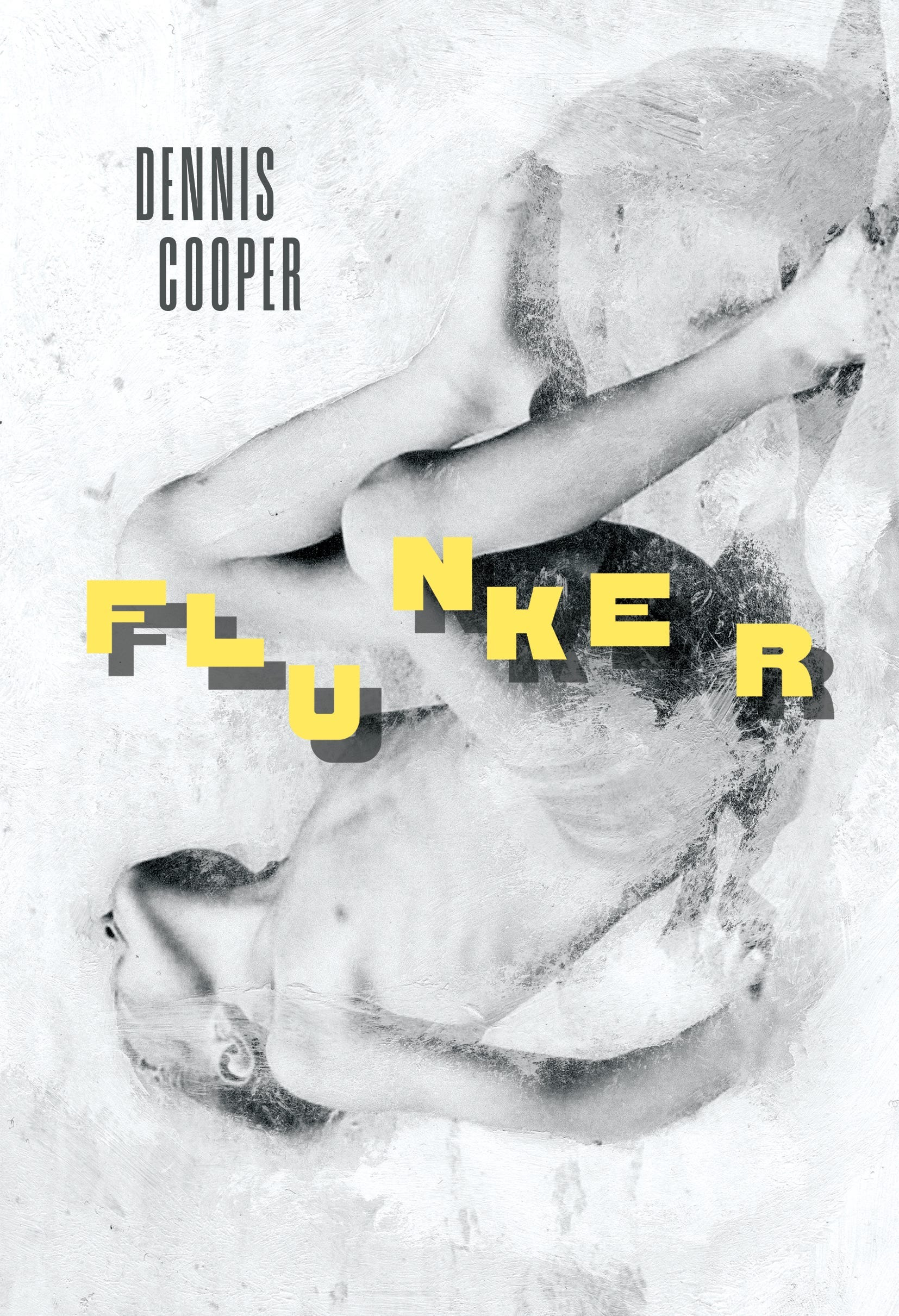
Minet: Tell me about Flunker. I haven't read it yet but hear it’s kind of a B-side of previously unreleased material. Or is there also new stuff in there?
DC: Most of the work in Flunker is older to one degree or another. Some of the works are things I had originally written to be parts of novels (especially 'I Wished' and 'The Marbled Swarm') that didn't work out, and that I went back to and finished and polished up, All but two of the pieces are new at least in the sense that they weren't finished until I put that book together.
Minet: Okay, now some rapid-fire questions to end. First one: What are some of your favorite books and movies and albums of the year so far?
DC: There are a lot, but I'll try to keep it to a few. Books: Mark Doten 'Whites', sasha hawkins 'FOR DISOBEYING', Charlotte Northall 'Practicing Dying', Laura Vasquez 'The Endless Week'. Films: Harmony Korine 'Baby Invasion', Julian Castronovo 'Debut', Mona Convert 'UN PAYS EN FLAMMES'. Albums: Destroyer 'DAN’S BOOGIE', Guided by Voices 'UNIVERSE ROOM', Backxwash 'ONLY DUST REMAINS'.
Minet: What’s your favorite theme park attraction of all time?
DC: Mr. Toad’s Wild Ride, at Disneyland. Classic, ultra-influential dark ride prototype.
Minet: What Guided by Voices song should readers listen to as they read this interview?
DC: 'Redmen and their Wives'
Minet: How do you feel about Timothée Chalamet?
DC: I think he's an immensely shallow, limited actor who has bewilderingly seemed to convince otherwise intelligent people that he's very talented.
Minet: Fuck, marry, kill: Antoine Monnier, Pierre Buisson, Pierre Clémenti.
DC: Fuck Antoine Monnier, marry Pierre Clementi, kill Pierre Buisson
Minet: And which one of your books would you like to see me translate first? ;)
DC: The one you want to translate. Seriously.
 | Um post convidado por
|